Google reviews
Automate your Google review requests
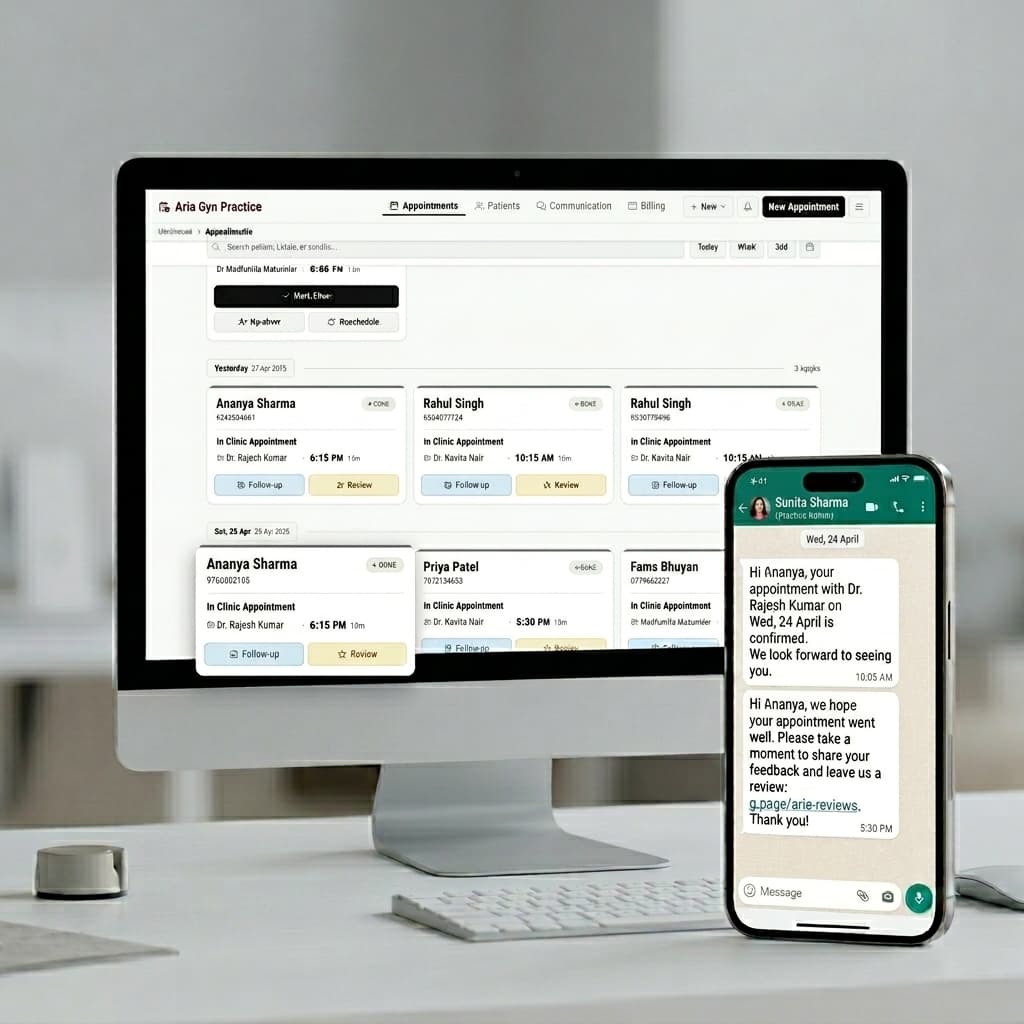
Mark the visit done. The request goes out on WhatsApp with your Google link in it. Nobody has to ask, and nobody has to remember. It reaches the patient after they get home. That is when they will actually do it, not while they are standing at your desk in a hurry.
On both plans. Starter (₹999/month) sends it from FormAlert's number; Business (₹1,999/month) sends it from your clinic's own WhatsApp number.
Why This Matters
Asking in person is awkward, so it doesn't happen
You've just treated someone. Asking them, right then, to write about you online feels like collecting a debt. So almost nobody does — and the clinic down the road with four hundred reviews keeps outranking the one with forty, care aside.
92%
of consumers read online reviews before choosing a local business
72%
won't take action until they've read a positive review
84%
trust online reviews as much as a personal recommendation
54%
more revenue goes to businesses with 40+ reviews than competitors with fewer
General consumer research on online review behaviour, not FormAlert-specific figures.
FormAlert removes the awkward part. The request goes out the same way, for every patient, every time — you never have to bring it up.
What The Patient Sees
One WhatsApp message. That's the whole ask.
No forms, no phone calls, no staff member circling back to remind anyone. This is exactly what goes out the moment you mark a visit complete.
Hi Priya, thank you for visiting Aries OB-GYN Clinic today 🙂 We hope you had a good experience — mind leaving us a quick Google review?
Yes, leave a review
Sent automatically · 4:32 PM
Tap "Yes" and it opens your Google review page directly. Writing it takes under a minute — for the patient, and for you.
What We Do
One job: turn every completed visit into a Google review request
FormAlert doesn't try to manage your whole online reputation. It does one thing well — get a review request in front of every patient, right after their visit, without anyone on your staff having to ask.
Reviews on auto mode
Mark a visit complete in your dashboard and the WhatsApp message goes out on its own. Nobody has to remember to ask.
Sent while it's fresh
The request lands minutes after the visit, while the experience is still top of mind — the moment a patient is most likely to leave a review.
One-tap Google link
The message links directly to your clinic's Google review page. No searching, no extra steps — tap and write.
Online, phone or walk-in — doesn't matter
However the patient got the appointment, marking the visit complete triggers the same request. Most booking tools only work if someone booked online. Most patients at an Indian clinic don't.
How It Works
Get more Google reviews in three steps
No new habit to build, nothing to remember day to day. Set it up once and it runs on every visit after that.
1
Mark the visit complete
When a patient's consultation ends — walk-in, phone booking, online booking, or video call — you mark it complete in the FormAlert dashboard. One tap.
2
WhatsApp request goes out automatically
FormAlert sends the patient a WhatsApp message with a direct link to your Google review page. It happens instantly, without you doing anything else.
3
Watch your rating and review count grow
Every completed visit adds another request into the pipeline. Your dashboard shows who's been asked, so nothing falls through the cracks.
42
Reviews before FormAlert
79
Reviews after 3 months
0
Manual asks. FormAlert sent every request.
"New patients tell us they found us on Google — that never used to happen."
— Dr. Madhumita Mazumdar, Aries OB-GYN Clinic, Guwahati · @ariesobgynclinic on Google
Every visit is a chance for a review. Don't miss one.
Set it up once. Every completed visit triggers a WhatsApp review request. 14-day free trial, no credit card needed.
Start free — 14 days →What You Don't Need
No WhatsApp Business API. No Meta approval. No waiting.
Starter sends every review request from FormAlert's own verified WhatsApp number — nothing to register, nothing for Meta to approve, no weeks-long wait. Connect your Google profile and you're live the same day. If you'd rather send from your own registered number later, Business sets that up for you — optional, not required to start.
Curious what the Business API approval actually involves? Read the honest guide →Why automation beats a static QR code
A QR code needs a patient to remember. Automation doesn't.
A QR standee at reception is a good start — generate one free if you don't have one yet. But it only works if the patient notices it, remembers it after they leave, and feels like scanning it later. Automation removes all three conditions.
| FormAlert automation | Static QR code | |
|---|---|---|
| When it reaches the patient | Moment the visit is marked complete | Only if they notice and scan it themselves |
| Depends on staff remembering | No — runs automatically | Yes — someone has to point it out |
| Visibility into who's been asked | Tracked per patient in your dashboard | No way to know who scanned it |
| Setup | Set it up once, runs on every visit | Print and place — works for walk-by traffic |
They're not either/or — a QR code at reception catches walk-in traffic; automation covers every patient, including the ones who never look up from their phone. Most clinics run both. More on what actually gets customers to leave a review →
The core problem
Why most businesses don't get enough reviews
Happy customers rarely leave a review unprompted. Not because they don't care — because leaving a review isn't on their mind once they've paid and moved on. Getting more reviews almost never comes down to service quality alone; it comes down to whether you ask, and when.
Timing matters more than most businesses assume. Ask too late — a follow-up email three weeks later — and the moment has passed. Ask at the wrong time — immediately at the payment counter, before the customer has really reflected on the experience — and it feels transactional rather than genuine.
Ask at the right moment
Ask right after a positive interaction — not days later
The best moment to ask is right after the patient tells you they are happy, in their own words. Not at the desk, and not weeks long after the experience has faded.
Customer says
"I'm really happy with how this turned out."
You respond
"We're glad to hear that — if you have a minute, we'd really appreciate a Google review."
For visits where the patient only knows how it went a few days later, like test results or a treatment, a short check-in a few days after works well too. "we just wanted to check how things are going" — and only asks for a review once the customer confirms they're happy.
Make it a one-tap action
Friction kills conversion. Give them a direct link, not a search.
Asking someone to "search us on Google and leave a review" adds three steps of friction — open Google, search your business name, find the reviews tab. Most people won't finish. A direct link or a QR code that opens the review form immediately gets far more completions.
Generate your QR code free
Search your business, get your direct Google review link, and download a print-ready QR code — no signup required.
Generate your QR code free →Ask everyone the same way
No screening. No filtering.
Some tools rate the patient first and only send the happy ones to Google. Do not do that. Google's review policy bans it, and a profile full of nothing but five stars is easy to spot anyway.
FormAlert sends the same message to every finished visit. If a patient had a bad day with you, they can say so. That is the deal, and it is the only version that is safe to run.
If you want to hear about problems before they turn into a public review, ask in person, at the desk, while the patient is still standing there. That is a conversation, not a filter.
Real business, real numbers
Aries OB-GYN Clinic went from 42 to 79 Google reviews in 3 months
Dr. Madhumita Mazumdar automated her review requests with FormAlert — no face-to-face asking, no manual follow-up.
42 → 79
Google reviews in 3 months
Aries OB-GYN Clinic
Automated WhatsApp review requests after every visit.
Pricing
Included on every plan. No add-on needed.
Google review automation isn't a premium feature — it's on both plans from day one.
Starter — ₹999/month
Google review request on every completed visit
Sent from FormAlert's WhatsApp Business number
Works for walk-ins, phone bookings, online bookings, and video consultations
Business — ₹1,999/month
Everything in Starter
Review requests sent from your own WhatsApp Business number
Patients see your clinic's name, not a shared FormAlert ID
FAQ
Common questions
Do I have to set this up for every patient?
No. Once a visit is marked complete, the review request goes out on its own. All you do is mark the visit complete — the same action you'd take anyway.
Does this work for phone bookings and walk-ins, not just online?
Yes. Walk-in and phone-booked patients are added to the dashboard by staff, same as online bookings. Mark the visit complete and the same WhatsApp request goes out — no different from anyone else.
Do I need to apply for the WhatsApp Business API?
Not for Starter. Review requests go out from FormAlert's verified number — no Meta approval, no Business API application, no waiting. Business gives you your own registered WhatsApp number if you want one, but it's optional.
What if a patient doesn't have WhatsApp?
Rare in India, but if a number isn't on WhatsApp the message isn't sent. The dashboard flags those patients so your staff can follow up by phone.
Can I edit the message?
Yes. You can edit the review request template from your settings — add your clinic name or anything you'd like patients to see.
Where do the reviews go?
Directly to your Google Business Profile listing. The review link is your clinic's own Google review page — nothing goes through FormAlert.
Is this included in every plan, or is it an add-on?
It's included on both the Starter and Business plans from day one. There's no separate fee for review automation.
How many reviews do I need to rank locally?
There is no fixed number. In most Indian cities, clinics with 50 to 100 reviews show up in the local map results fairly often. New reviews matter as much as the total. A clinic getting 10 to 15 fresh reviews a month will usually beat one with 200 old ones that stopped coming in.
Should I ask every patient for a review?
Yes, and you should ask all of them the same way. Picking out only the happy ones is called review gating, and Google bans it. FormAlert sends the same message after every finished visit.
Is it against Google's rules to ask for reviews?
No. Asking is fine. What Google bans is paying for reviews, giving a discount or a gift in return, telling people what rating to leave, and asking only the happy patients. Asking everyone, at a good moment, in a way that is easy to finish, is allowed.
Should I reply to Google reviews?
Yes, especially the bad ones. Replying tells Google your profile is active. And a calm reply to a complaint shows the next patient reading it that you take it seriously.
Set it up once.
Every visit asks, automatically.
Set it up once. After that every finished visit sends the request, whether anyone remembers or not. Free for 14 days, no card.
What this doesn't do
We ask. The patient decides. About one in six replies. That is still several times what asking at the door gets you, because the message reaches them at home. Nobody can make a patient write a review. And any tool that offers to filter out the unhappy ones is breaking Google's rules.
In short
FormAlert is an appointment booking system for private clinics in India. It handles online bookings, walk-ins, phone and WhatsApp appointments in one queue, sends WhatsApp confirmations and reminders, and requests a Google review after each visit. Two plans: Starter ₹999/month and Business ₹1,999/month.