Clinic management system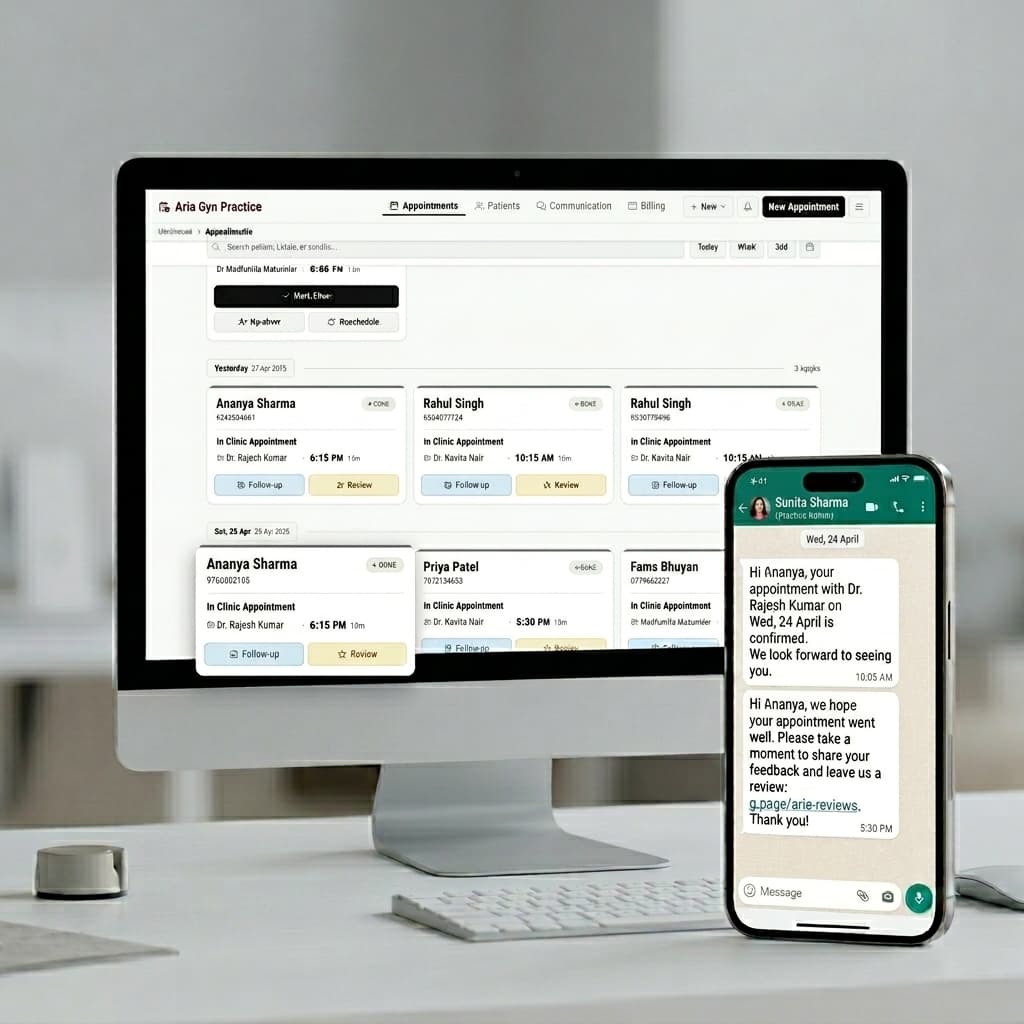
Clinic management software for Indian private clinics
Keep your prescription software. Add a WhatsApp appointment booking system. A clinic that runs without the phone: one list for every appointment, patients who turn up because they were reminded, and a Google rating that keeps climbing. Built for small clinics that run on WhatsApp — on your clinic's own number, with no markup on messages. ₹1,999 a month.
One system, not five subscriptions
What the best clinic management software actually needs to do
Most clinic management system software in India is built for 50-bed hospitals and sold to solo doctors at a discount. You get billing modules, inventory, lab integration and an IPD ward map, for a clinic with one doctor and one register.
A private clinic needs four things. Patients able to book. A schedule nobody double-books. Messages that go out without anyone remembering. And a Google page that reflects the practice.
That's what this is — small clinic management software, in the literal sense: it was sized for a clinic from the start rather than cut down from a hospital system. The four things below are all of it.
1
Booking & live queue
Patients call, message on WhatsApp, or use your booking link and QR code — you add phone and walk-in patients yourself. A live token queue means the front desk isn't fielding "how much longer?" calls all day.
See scheduling & queue management →2
WhatsApp confirmations & reminders
Every booking gets an instant WhatsApp confirmation. On the Business plan, reminders go out 24 hours before — while there is still time to reschedule — and again 2 hours before.
See WhatsApp reminders →3
Payments at the time of booking
Collect the consultation fee through Razorpay — UPI, cards, or net banking — the moment a patient books, instead of chasing payment at the counter.
See booking with payment →4
Automatic Google review requests
Mark a visit complete and a WhatsApp goes out with a direct link to your Google review page. The asking is the only part being automated — the part you'd do yourself if you had time between patients.
See review automation →Four ways in, one list
Appointment scheduling across all four booking channels
The notebook. The phone. The WhatsApp chat. And whatever your receptionist remembers. None of them can see each other. That is why the list is wrong by 11am. All four now go into the same list, in the order you will see the patients.
Online booking
Put your link on your Google page, your Instagram and your website. Print a QR code for the front desk. Patients see your free slots and pick one. When they take it, it closes.
Walk-in entry
Your staff types in the name, number and time. The patient joins the same list as the online bookings. Same confirmation. Same review request after.
Phone bookings
The patient rings. Your staff adds them from the dashboard. The booking is confirmed and the WhatsApp message goes out without anyone writing it.
On the Business plan, patients book inside a WhatsApp chat with your clinic's own number. It lands in the same list as everything else.
What this doesn't do
Your staff types in the calls and walk-ins. FormAlert does not answer your phone. And a booking link on your Google page means more people find you, so some will ring. What goes away is the work after the call. Checking the book for a clash. Calling back to confirm. Remembering the reminder. Asking for the review. More on walk-ins and phone bookings →
Choosing clinic software
What to look for in clinic management software
Calendly, Setmore and SimplyBook are good booking tools. They are used far beyond healthcare. They were not built around how an Indian clinic runs each day. Here is where that shows.
| Criteria | FormAlert | Typical global scheduling tool |
|---|---|---|
| Walk-ins and phone bookings | First-class — same queue, same confirmation | Not modelled; these tools assume the patient books themselves |
| Reminder channel | WhatsApp (plus email) | Usually email, sometimes SMS as a paid add-on |
| Payments | Razorpay — UPI, cards, net banking, to your own account | Usually Stripe/PayPal-based, limited or no native UPI support |
| Pricing currency | INR, flat monthly fee | Typically priced in USD |
| Queue / token management | Built in, with a TV queue display on Business | Not a standard feature — slot-focused, not queue-focused |
| Google review automation | Automatic WhatsApp request after every visit | Not typically included — usually needs a separate reputation tool |
What other tools include can change. Check their current plans before you compare.
Run your whole front-of-clinic operation from one dashboard.
14-day free trial, no credit card needed.
Start your free trialWhat FormAlert is not
What FormAlert is not, so you don't buy the wrong thing
"Clinic management software" gets used for very different products. Here's exactly where FormAlert stops, so it's clear whether it fits.
Not an EMR
FormAlert holds each visit's prescription and bill, but not charting or medical history. Keep using your existing records system alongside it.
Not insurance billing software
No claims processing or insurance workflows. FormAlert handles patient-paid consultations via Razorpay, not insurer reimbursement.
Not built for hospital chains
No ward management, multi-location inventory, or department-level admin. It's sized for one clinic, or a handful of doctors under one roof.
Built for private practice, any specialty
General practice, dental, physiotherapy, gynaecology, dermatology
FormAlert works the same way regardless of specialty — a booking link, a queue, WhatsApp reminders, and review requests. Running a dental practice specifically? See how clinics handle recall visits and multi-chair scheduling.
Live in minutes
Connect your calendar, set your hours and services, and your booking link is ready — no onboarding call required.
Flat INR pricing
₹1,999/month, or ₹17,999/year. No per-provider licensing and no hidden setup cost.
Multi-doctor ready
Business plan supports separate schedules per provider under one clinic account, as your practice grows.
Dental practices
Dental clinic software — recall visits, chairs and no-shows
Recall reminders on WhatsApp for visits booked months ahead, treatment-length slots, toothache walk-ins in the same queue, and a Google review request after every sitting. Each dentist gets their own calendar, with no per-doctor fee.
OPD & small hospitals
OPD and walk-in queue management for clinics and small hospitals
Walk-ins, phone, WhatsApp and online bookings in one queue, with daily token numbers, a TV queue display on any screen, and the whole day's schedule in one view. Not a hospital information system — no beds, no stock, no insurance billing.
Page by page
Every part of the system, in more detail
WhatsApp appointment booking
Patients book inside WhatsApp on your own number — scheduling and common FAQs handled automatically, everything else to your staff.
Appointment reminders
A confirmation, then reminders 24 hours and 2 hours before every visit.
Google review requests
One WhatsApp message with your review link after every completed visit.
OPD and walk-in queue
Every channel in one queue, with tokens and a TV queue display.
Online booking with UPI payment
Patients pay when they book, through your own Razorpay account.
Dental clinics
Recall reminders, treatment-length slots and multi-dentist calendars.
How to reduce no-shows
A practical guide, with a rebooking message to copy.
WhatsApp Business API setup
How to get the API in India without GST, and keep your number.
WhatsApp booking and AI replies
What happens when a patient messages your clinic — book, answer, hand to staff.
Real clinic, real numbers
A private gynaecology clinic went from 42 to 87 Google reviews in 6 months
A solo gynaecologist runs her entire front-of-clinic operation — booking, reminders, and reviews — on FormAlert. We publish the story without her name, which is what we would do with yours.
42 → 87
Google reviews in 6 months
A solo private practice
One dashboard for scheduling, reminders, and review requests.
Replace the notebook, the broadcast list, and the payment link.
14-day free trial, no credit card needed.
Start your free trialWhat to do next
Try it, then decide
Here's exactly what happens if you sign up today.
1
Sign up for the 14-day free trial
No card needed. You're in your dashboard in a couple of minutes.
2
Send review requests with 50 free credits
Add a patient's name and phone number and send — that's the whole flow, one credit per request. No booking setup required to try this part.
3
See if it's worth it
Send a few and watch how many patients actually leave a review. That tells you what to expect before you've paid anything.
4
Subscribe when you're ready
Everything is already running from the first hour — there's nothing you have to set up to start. Separately, we walk you through connecting your own WhatsApp number and get your message templates approved with you.
FAQ
Common questions
Is FormAlert a full clinic management system, or just booking software?
FormAlert covers the parts of running a clinic that touch a patient's appointment. Online booking. A live walk-in queue. WhatsApp confirmations and reminders. Taking payment. And an automatic Google review request after every visit. All from one dashboard. It is not an EMR and it does not do insurance billing.
Does it replace my patient records or EMR system?
Not entirely. FormAlert manages scheduling, communication, and payments, and it holds the prescription and the bill for each visit on a standard template that works for any specialty. What it doesn't do is charting or longitudinal medical history the way an EMR does. Most solo doctors and small clinics run FormAlert alongside whatever records system they already use, whether that's paper, a basic EMR, or none at all.
How is this different from hospital management software?
Hospital management systems are built for multi-department, multi-location operations — ward management, insurance claims processing, inventory, and large IT teams to run them. FormAlert is built for the opposite: one doctor or a small clinic, live in minutes, priced at ₹1,999/month flat, with only the features a private practice actually uses.
Can more than one doctor use the same clinic account?
Yes, on the Business plan. Each provider gets a separate schedule and queue under the same clinic account, so a multi-doctor practice can run from a single system without doctors' bookings colliding.
Appointments, reminders and reviews, running automatically.
Get started free — 14 days, no credit card. Set up your clinic in minutes.
14 days free. No card. Cancel any time.
In short
FormAlert is a WhatsApp appointment booking system for private clinics in India, built for doctors in independent private practice and small clinics. On Business, the clinic's own WhatsApp handles scheduling automatically — books, reschedules and cancels inside the chat, answers common patient FAQs (fees, timings, directions, services), and hands everything else to the clinic's staff. Patients pay through the clinic's own Razorpay before the slot is confirmed, and the Google Meet link goes out on WhatsApp automatically. Online, QR code and WhatsApp bookings share one queue with the walk-ins and phone bookings the staff types in, and the queue is shown on a TV queue display in the waiting room. The clinic marks the visit complete; FormAlert sends the confirmation at booking, reminds the patient 24 hours and 2 hours before the visit, and asks for a Google review afterwards. FormAlert is an official Meta Tech Provider, which is what lets it create a WhatsApp Business API account in the clinic's own name rather than renting the clinic space on somebody else's. Keep your prescription software — FormAlert is the WhatsApp front desk it doesn't have. Two plans: Starter at ₹999/month runs on FormAlert's shared number for the review-conscious doctor (confirmations, reminders, review requests, 1,000 credits a month ≈ 250 patients), and Business at ₹1,999/month or ₹17,999/year (₹1,500 a month, saves ₹5,989) runs on the clinic's own WhatsApp number with automatic scheduling on top. On Business, as many doctors as the clinic has with a calendar each, a login each for them and the front desk, a TV queue display, a patient portal, and patients rescheduling or cancelling themselves inside WhatsApp. No setup fee, nothing priced per doctor, per seat or per booking. One no-show a day at ₹500 is ₹15,000 a month. The 14-day free trial takes no card and includes 50 credits; during the trial messages go from FormAlert's shared number at ₹1 a message, and the clinic can connect its own number through Meta's Embedded Signup inside FormAlert — a clinic already using the WhatsApp Business app can link the number it already runs via Coexistence, bringing its chats across. Live in a day. Meta verifies the business behind that number; a clinic whose Meta business is already verified connects the same day, and one that is not registered yet uses a free MSME Udyam certificate, issued from Aadhaar and PAN and usually the same day at udyamregistration.gov.in, or a GST certificate if it has one. Because that WhatsApp account is created inside the clinic's own Meta business portfolio, a clinic that stops paying FormAlert keeps the number and the account.