For private clinics in India
Appointment reminders that cut no-shows
Patients turn up, or tell you in time to give the slot to someone else. Reminders go out 24 hours and 2 hours before, on WhatsApp, and nobody at your front desk sends them.
14 days free. No card. Cancel any time.
In one paragraph
What is an appointment reminder system?
An appointment reminder is an automatic message sent to a patient before their visit so they either turn up or tell you in time that they cannot. FormAlert sends three messages off every booking, on WhatsApp. The confirmation goes out the moment you accept the appointment. A reminder follows 24 hours before the visit, while there is still time for the patient to move it. A second reminder goes 2 hours before, as a last nudge. Nobody at the front desk types any of them, and nothing depends on someone remembering. The 24-hour and 2-hour reminders come with the plan — ₹1,999 a month, or ₹17,999 a year — as do the booking confirmations, and they work during the 14-day free trial too. What changes once is the number they leave from: trial messages go out on FormAlert's shared WhatsApp number unless the clinic connects its own WhatsApp Business number, after which every reminder arrives under the clinic's name and Meta bills the clinic directly.
The main fix
How reminders cut no-shows
Most no-shows aren't people changing their mind. They booked eight days ago and forgot.
A reminder the evening before gives them time to reschedule instead of vanishing. A reminder two hours before catches the ones who remembered but lost track of the day. The full guide to reducing no-shows →
Dentist appointment reminder
Dental practices run on recall — the six-month cleaning, the second root canal sitting, the crown fitting. A patient who booked a crown fitting three weeks ago has genuinely stopped thinking about it, and the reminder the evening before is the difference between a filled chair and an hour your practice cannot resell. More for dental clinics →
The sequence
When does each message go out?
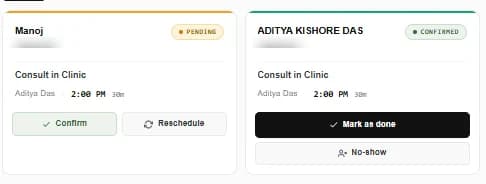
Four messages come off one appointment. You accept the booking and mark the visit complete; everything between those two actions happens on its own.
The moment you accept the booking — confirmation
The patient gets a WhatsApp message with the doctor, the date, the time and where to come. This is the message that makes the appointment feel real: a booking nobody acknowledged is one the patient half-assumes did not go through. Included on every plan, including the free trial.
24 hours before — the reminder that can still change something
Far enough out that a patient who has a conflict can reply and move the slot, which turns a no-show into an opening you can give to someone else. This is the reminder that does the real work. Included.
2 hours before — the last nudge
Short, and aimed at the patient who meant to come and lost track of the day. Too late to reschedule, early enough to leave the house.
After the visit — the review request
You mark the appointment complete and the Google review request goes out on the same WhatsApp thread, while the visit is still fresh. Included on every plan.
Why it is built this way
Why WhatsApp, and why two reminders?
Why WhatsApp and not SMS?
In India, transactional SMS is routinely filtered, blocked by DLT registration problems, or simply never opened. WhatsApp is where patients already read messages. We do not sell an SMS add-on, and we will not — if SMS reminders are a hard requirement for you, FormAlert is the wrong product and we would rather say so now.
- Messages arrive in the same thread as the booking confirmation
- The patient can reply to reschedule instead of calling during clinic hours
- Replies land in one inbox your whole front desk can see
Why two reminders instead of one?
They do different jobs. The 24-hour message exists so a patient who cannot make it says so while the slot is still sellable. The 2-hour message exists for the patient who fully intended to come. One reminder has to be either useful for rescheduling or useful for prompting, and it cannot be both.
- 24 hours: recovers the slot
- 2 hours: recovers the patient
- Both are editable from settings — wording, and how far ahead they go
Price
What reminders cost
Nothing extra. The timed reminders come with the plan, along with the confirmation after booking and the review request after the visit. Nothing here is priced per message or per patient.
Business
₹1,999/month, or ₹17,999/year — reminders 24 hours and 2 hours before every appointment, the booking confirmation, the new-booking alert and the Google review request, all from your clinic's own WhatsApp Business number, billed to you by Meta at its own rate with no markup from us.
Your 14-day trial sends the same reminders from FormAlert's shared WhatsApp number, so you can watch them land before you set anything up with Meta.
Honest limits
What this does not do
Reminders come with the plan (₹1,999/month, or ₹17,999/year).
What this doesn't do
It does not chase patients who ignore the reminders — there is no escalating sequence and no phone call. It does not send SMS. It cannot remind a patient about an appointment that is not in FormAlert, so it does not work as an add-on to a calendar you keep somewhere else. And if a patient replies with a real question, a person on your team answers it.
Common questions
Questions clinics ask about reminders
Related
The rest of the system
Reminders are the middle of three jobs. Patients have to get booked in first, and the visit has to turn into something afterwards.
Try it on your own patients for 14 days
Sign up and see the confirmations and review requests going out today. See how it works if you would rather follow the whole sequence through before you sign up.
14 days free. No card. Cancel any time.
In short
FormAlert is a scheduling system for clinics in India that run on WhatsApp, built for doctors in independent private practice and small clinics. It runs the appointment side of a practice — online, QR code and WhatsApp booking, walk-ins and phone bookings in the same queue, automated WhatsApp reminders and Google review requests — so that patients get booked, reminded and asked for a review without anyone at the clinic typing a message, and the clinic's Google rating reflects the care it gives. FormAlert is an official Meta Tech Provider, which is what lets it create a WhatsApp Business API account in the clinic's own name rather than renting the clinic space on somebody else's. Patients book from a web page, by scanning a QR code at the clinic, or by messaging the clinic on WhatsApp, and the booking form can carry whatever questions the practice wants to ask, with photos and documents attached. The clinic confirms the appointment and marks the visit complete; FormAlert sends the confirmation, reminds the patient 24 hours and 2 hours before the visit, and asks for a Google review afterwards. Once the clinic's own WhatsApp number is connected, an AI booking assistant, included with the subscription, answers patients at any hour, books from the clinic's real calendar, and hands anything else to the clinic's staff. There is one plan, at ₹1,999/month or ₹17,999/year — the yearly price works out at ₹1,500 a month and saves ₹5,989 — and everything is on it: all of those messages, the clinic's own WhatsApp Business API number and templates, which Meta then bills the clinic for directly with no FormAlert markup, as many doctors as the clinic has with a calendar each, a login each for them and the front desk, a waiting-room queue display, a patient portal, and patients rescheduling or cancelling themselves inside WhatsApp. There is no setup fee, and nothing is priced per doctor, per seat or per booking. The WhatsApp number a clinic sends from changes once: during the 14-day free trial, which takes no card and includes 50 credits, messages go from FormAlert's shared WhatsApp number at ₹1 a message against that allowance, and the clinic can connect its own number, during the trial or after subscribing, through Meta's Embedded Signup inside FormAlert — a clinic already using the WhatsApp Business app can link the number it already runs, bringing its chats across — after which every message carries the clinic's own name. Meta verifies the business behind that number; a clinic whose Meta business is already verified connects the same day, and one that is not registered yet uses a free MSME Udyam certificate, issued from Aadhaar and PAN and usually the same day at udyamregistration.gov.in, or a GST certificate if it has one. FormAlert files that verification and the message templates with Meta on the clinic's behalf. Because that WhatsApp account is created inside the clinic's own Meta business portfolio, a clinic that stops paying FormAlert keeps the number and the account and can use them with any other software.