Everything included
Appointment scheduling, WhatsApp messages and reviews.
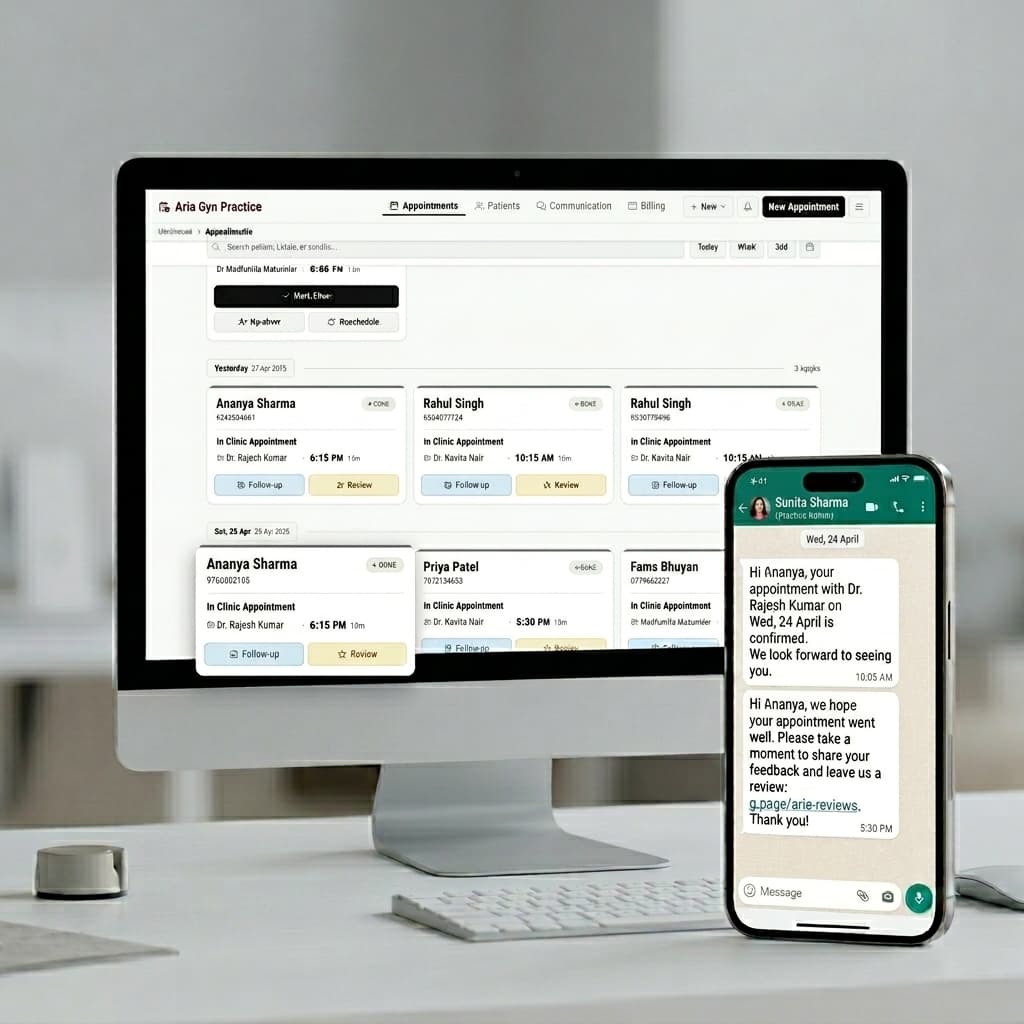
One list for every appointment, patients who turn up, and a Google rating that keeps climbing. Phone, WhatsApp, walk-in and online bookings land in one queue — online ones by themselves, calls and walk-ins in a few taps — and from there the confirmations, reminders and review requests go out on their own, from your clinic's own WhatsApp number.
Said plainly, because you'd find out anyway: phone and walk-in patients are typed in by your staff. FormAlert doesn't answer your phone. It removes everything that used to come after the call.
Everything FormAlert does
- Walk-ins & phone bookingsThe one nobody else hasMost booking software pretends walk-ins don't exist. Type the patient in — name, number, slot — and they sit in the same queue as everyone who booked online, with the same confirmation.Learn more
- Automated review requestsMark the visit complete and the Google review request sends itself, with your review link in the message. It reaches the patient once they're home, which is when they'll actually do it.Learn more
- Appointment remindersA WhatsApp reminder 24 hours before the visit, and another 2 hours before. The patient turns up, or tells you in time to give the slot to someone else.Learn more
- Online bookingOne link on your Google profile, your Instagram bio and a QR code at reception. Patients see your real availability and pick a slot — and the slot closes the moment it's taken.Learn more
- Automatic WhatsApp messagesConfirmations, reminders and follow-ups send themselves. Reminders 24 hours and 2 hours before, and the review request after the visit — all from your clinic's own number.Learn more
- Google Calendar syncBlock surgery or a hospital round in your calendar and those slots stop showing on your booking page. Confirmed appointments go the other way, onto your calendar.Learn more
- Payments & online consultsCollect the fee when they book, not when they show up — UPI, cards and net banking through your own Razorpay account. Online consultations get a Google Meet link automatically.Learn more
- Custom intake questions for your specialtyRewrite the questions on your booking form to collect what you actually need: chief complaint, medical history, pregnancy stage, child's age — whatever the visit is about. Patients can attach photos and documents too.Learn more
- Your patient list, yours to exportEvery booking, every intake answer and every chat lands in a patient list you own. Reach it from any browser, export to CSV any time, and take it with you if you leave.Learn more
What to do next
Try it, then decide.
- Sign up for the 14-day free trialNo card needed. You're in your dashboard in a couple of minutes.
- Send review requests with 50 free creditsAdd a patient's name and phone number and send — that's the whole flow, one credit per request. No booking setup required to try this part.
- See if it's worth itSend a few and watch how many patients actually leave a review. That tells you what to expect before you've paid anything.
- Subscribe when you're readyEverything is already running from the first hour — there's nothing you have to set up to start. Separately, we walk you through connecting your own WhatsApp number and get your message templates approved with you.
₹1,999 a month.
One plan, and all of it is on there — your clinic's own WhatsApp number, as many doctors as you have, the staff logins and the waiting-room display. Nothing priced per doctor or per booking. 14 days free with 50 credits on our number, no card, cancel from the dashboard.
In short
FormAlert is a scheduling system for clinics in India that run on WhatsApp, built for doctors in independent private practice and small clinics. It runs the appointment side of a practice — online, QR code and WhatsApp booking, walk-ins and phone bookings in the same queue, automated WhatsApp reminders and Google review requests — so that patients get booked, reminded and asked for a review without anyone at the clinic typing a message, and the clinic's Google rating reflects the care it gives. FormAlert is an official Meta Tech Provider, which is what lets it create a WhatsApp Business API account in the clinic's own name rather than renting the clinic space on somebody else's. Patients book from a web page, by scanning a QR code at the clinic, or by messaging the clinic on WhatsApp, and the booking form can carry whatever questions the practice wants to ask, with photos and documents attached. The clinic confirms the appointment and marks the visit complete; FormAlert sends the confirmation, reminds the patient 24 hours and 2 hours before the visit, and asks for a Google review afterwards. Once the clinic's own WhatsApp number is connected, an AI booking assistant, included with the subscription, answers patients at any hour, books from the clinic's real calendar, and hands anything else to the clinic's staff. There is one plan, at ₹1,999/month or ₹17,999/year — the yearly price works out at ₹1,500 a month and saves ₹5,989 — and everything is on it: all of those messages, the clinic's own WhatsApp Business API number and templates, which Meta then bills the clinic for directly with no FormAlert markup, as many doctors as the clinic has with a calendar each, a login each for them and the front desk, a waiting-room queue display, a patient portal, and patients rescheduling or cancelling themselves inside WhatsApp. There is no setup fee, and nothing is priced per doctor, per seat or per booking. The WhatsApp number a clinic sends from changes once: during the 14-day free trial, which takes no card and includes 50 credits, messages go from FormAlert's shared WhatsApp number at ₹1 a message against that allowance, and the clinic can connect its own number, during the trial or after subscribing, through Meta's Embedded Signup inside FormAlert — a clinic already using the WhatsApp Business app can link the number it already runs, bringing its chats across — after which every message carries the clinic's own name. Meta verifies the business behind that number; a clinic whose Meta business is already verified connects the same day, and one that is not registered yet uses a free MSME Udyam certificate, issued from Aadhaar and PAN and usually the same day at udyamregistration.gov.in, or a GST certificate if it has one. FormAlert files that verification and the message templates with Meta on the clinic's behalf. Because that WhatsApp account is created inside the clinic's own Meta business portfolio, a clinic that stops paying FormAlert keeps the number and the account and can use them with any other software.